Article: KARA DIOGUARDI | A PLACE OF TRUTH
KARA DIOGUARDI | A PLACE OF TRUTH
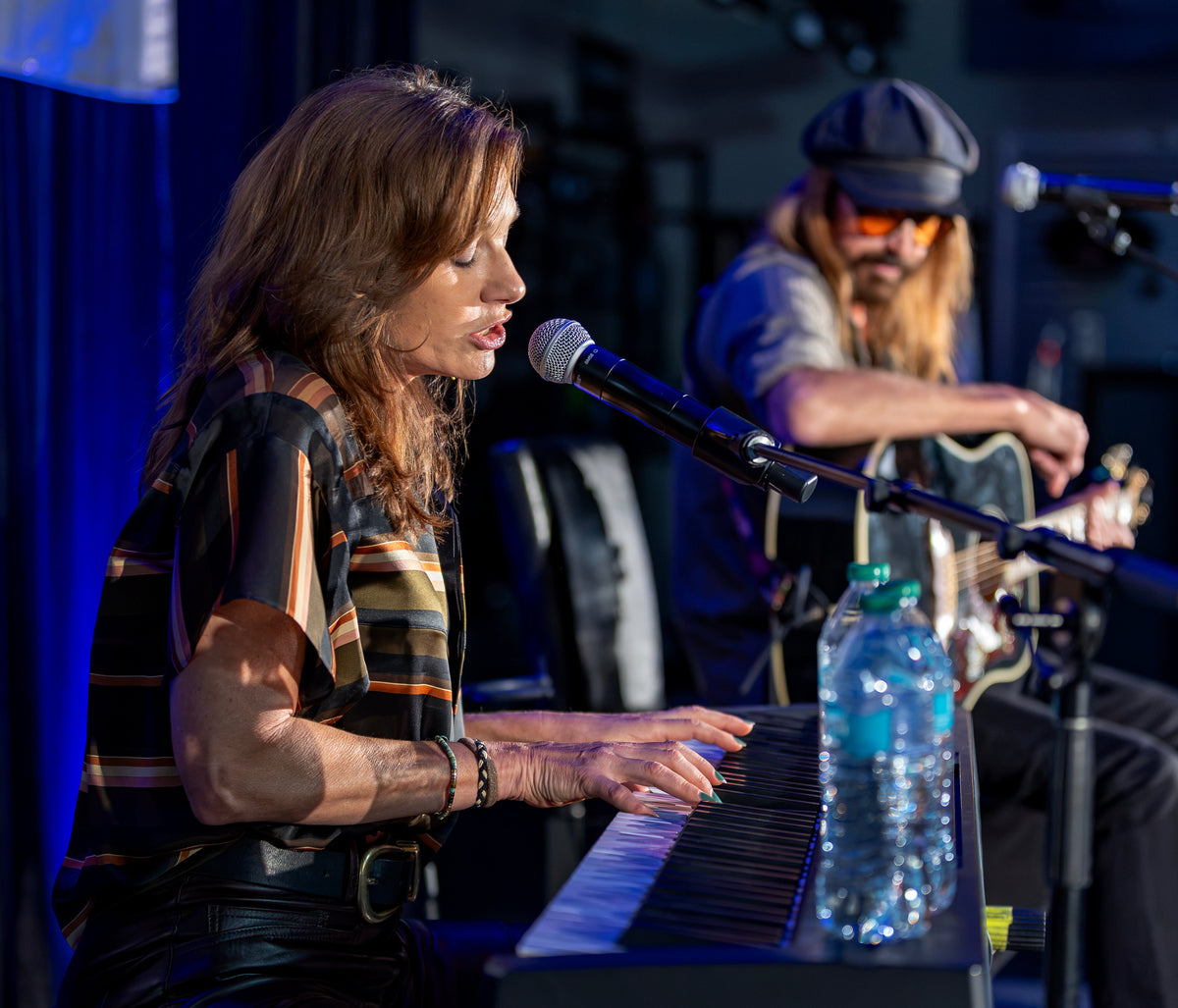
Photo: Chris Neal / Woods Photoghraphy
Some songs seem to know where to find us.
They are there for a first dance at a wedding, when two people step onto the floor and everyone else disappears for a few minutes. They find us during hard stretches and offer a little comfort, or put words around something we haven't quite figured out how to say ourselves. They pull us onto crowded dance floors with friends. They ride with us on long stretches of open road, when the right playlist, two yellow lines reaching toward the horizon and nowhere we have to be, make it a little easier to be exactly where we are.
Music has a way of attaching itself to our lives. Years later, a few notes can bring back the room, the road, the person or even the version of ourselves who first heard them.
What we don't always think about is who felt it first, and why they decided to put that feeling or experience into a song.
Some of the songs woven into the biggest and smallest moments of our lives weren't always written by the people we hear singing them. Before the recording studio, the radio or the playlist, there was a songwriter trying to capture something that mattered to them in that moment. Love. Loss. Anger. Hope. A bad decision. A good night. Sometimes it's just an old truck or a great dog. If it's a country song, there's a decent chance somebody figured out how to include both.
If hearing those songs can make us feel something so deeply, imagine being the person who lived some piece of the story behind them.
At the inaugural San Juan Songwriters Festival in Durango, Colorado, audiences had the rare chance to hear that side of the music. Accomplished songwriters traded songs and the stories behind them in intimate rooms around town. They talked about the people, places and moments that started the songs, what they were feeling when they wrote them and how something that once belonged to their own lives eventually found its way into ours.
A songwriter telling the story behind a song may be as close as we can get to taking a photograph of it.
The song is still the song. But now there is something more in the frame. A room. A face. A breakup. A memory. A night years ago that somehow traveled through another artist's voice and became part of someone else's life.
Among the songwriters sharing those stories in Durango was Kara DioGuardi, who has spent much of her career turning pieces of her own experience into songs that eventually found their way into other artists’ voices.
Her name may not always be the one on the album cover, but there is a good chance you know her work. DioGuardi is an 11-time Grammy nominee whose songs have appeared on more than 160 million records. Her credits include songs recorded by P!nk, Kelly Clarkson, Christina Aguilera, Carrie Underwood, Gwen Stefani, Celine Dion and dozens of others. She spent two seasons as a judge on American Idol, founded the music publishing and development company Arthouse Entertainment and has spent years teaching, mentoring and developing songwriters.
I caught up with DioGuardi after the festival to talk about what happens before a song becomes part of someone else's life, and what she has learned from a career spent helping people turn what they feel into something the rest of us can hear and feel for ourselves.
The accolades and numbers tell you something about her career. They don't tell you much about the how or the why.
“I think most of the best artists can only come from a place of truth,” DioGuardi said.
Sometimes an idea begins with something from her own life. The artist across the room may recognize the feeling but bring a completely different experience to it. They talk. They pull at it. Love, hurt, someone who broke your heart, something you wanted and never got. DioGuardi described digging deeper and deeper until they uncover what they're really trying to say and arrive at what she calls a “common denominator.”
It's the point where two different stories touch, and where a listener with an entirely different story can still recognize the feeling.
“I always have to start from a place of truth,” she said. “If it goes somewhere else because the artist I'm working with has another take on it or perspective, I'm okay with that because ultimately I'm there to help them tell their story.”
That ability has been refined across decades of writing rooms and collaborations with some of the most successful artists in music. But when DioGuardi talks about what she brings into those rooms, she begins somewhere more elemental than technique: the ability to feel.
“I've always used my truth,” she said. “My ability to feel and sort of uncover how that can affect a song is kind of what I bring to the room.”
Maybe that's part of the strange alchemy of a great song. Something that begins inside one person is shaped by another, recorded in someone else's voice and released into the world. Then it no longer belongs entirely to any of them.
It belongs to the couple who chose it for their first dance. The person who played it over and over because life hurt and somebody else finally seemed to understand. The friends singing too loudly together. The driver with the windows down, a great song turned up and a horizon out ahead they'll never actually catch.
DioGuardi believes music can make that kind of room in places far removed from record labels and recording contracts, too.
She describes music as a “healing art,” a place where people can “download” emotions and begin to make sense of what is happening inside them. That belief led her to create recording studios in recovery houses, where young people struggling with addiction could make music and speak honestly among their peers.
“It was like a sacred space for them to just feel their emotions,” she said.
DioGuardi saw young people use music to approach things they had been afraid to bring to the surface. Putting those experiences into words didn't erase them. But saying them, and having someone else hear and honor what was being said, could change their relationship to them.
“Once they kind of say it or face it, they realize it probably doesn't have the power they thought over them,” she said.
The same belief that music can connect people and give difficult experiences somewhere to go also sits behind Inspired Nation, the nonprofit DioGuardi co-founded to use music as a way to support young people in need.
Part of the idea came from something she had seen firsthand on American Idol. Young artists could walk onto a television stage and share their talent with millions of people. The show could draw enormous audiences and generate money, while the contestants themselves still faced an uncertain road once the cameras stopped rolling.
“It's not a golden ticket to the charts,” she said.
DioGuardi wanted some of that energy to travel in another direction. Through Inspired Nation, talent shows, songwriter rounds and other music events have raised money for youth-focused charitable organizations.
“I spent a lot of time thinking about that,” she said, “and thinking about how can we use our talents to make the world a better place?”
For someone whose career has been measured in chart positions, record sales and Grammy nominations, the question also says something about how her understanding of success has changed.
“Success for me back then was charts,” she said. “Success for me now is being creative every day, regardless of the outcome.”
It would be easy to read that as a rejection of the ambition that drove her earlier career. DioGuardi doesn't.
The years spent writing, competing, creating and pushing for the next opportunity built the career that now gives her room to define creativity more broadly. She can find it in songwriting, design, a project or even the way she approaches a friendship. The outcome no longer has to be a hit record for the act of creating to matter.
“I don't think my older self could be in the position without my younger self,” she said.
With hindsight, DioGuardi can also see some of the costs that came with pushing so hard. She said there were times she put herself “in a lot of harm's way” emotionally while pursuing her career, including situations involving people she now describes as “bad actors.”
Time has a way of making old decisions look obvious. We can see what followed, know how things turned out and judge choices made by someone who knew none of it. DioGuardi is trying to look back differently, with compassion for the person who had to make those choices without knowing where they would lead.
“I think at the end of the day, it's about having compassion for yourself,” she said.
Any decision, she explained, is made by the person we are at that particular moment, with whatever we know and whatever we are carrying at the time. Years later, it's easy to stand safely on the road we chose and wonder about the one disappearing in the other direction.
“You don't really know where it's going to lead you,” she said. “You did the best you could.”
For a person whose career has involved finding the right words, helping artists discover what they want to say and encouraging young musicians to decide what they really want from their lives, there is something fitting about where DioGuardi finds herself now. She is still asking some of those questions herself.
She talked about how much of early life comes with a loose set of directions. School. Work. Relationships. Family. There are milestones we recognize and people a few steps ahead who can tell us something about what might be coming. Eventually, though, the road becomes less marked.
“There's nobody to tell you anything,” DioGuardi said. “Nobody says, like, okay, this is what you do now.”
She calls it “the wild, wild West,” but she doesn't talk about that uncertainty as something to fear. There is freedom in it too. Without a prescribed next step, there is room to look honestly at the life you've built, decide what still fits and ask what you might want to build next.
“Part of it is asking yourself really hard questions about where you are in your life,” she said, “and do you have the courage to create a new path for yourself?”
For DioGuardi, finding that path isn't necessarily a solitary exercise. She talked about being honest with the people around us, including the people who support us, about not always knowing what's next. Sharing that uncertainty can start conversations, and those conversations can reveal possibilities we couldn't see on our own. Uncertainty, she said, “actually can be a great thing.”
Maybe that isn't so different from writing a song.
You begin with something true. You sit with it long enough to understand what you're feeling. You let someone else into it. Somewhere in that exchange, something that belonged only to you can begin to mean something to someone else.
DioGuardi has spent decades doing that with music, helping turn pieces of human experience into songs that travel farther than the people who wrote them could ever follow. They end up woven into lives the songwriter will never see, becoming part of first dances, heartbreaks, friendships, celebrations and ordinary Tuesday afternoons.
And sometimes they find us on an open road, the windows down and the music louder than it probably needs to be. The horizon is still out ahead, but we're in no particular hurry to reach it.
There will always be another mile, another question, another song, something else just beyond where we can see. We can spend the whole trip waiting to arrive, or we can turn up the music and pay attention to where we are.
Kara DioGuardi is still creating, still asking questions and still leaving room for whatever comes next. But after a career spent finding her own voice, she has also become pretty good at helping other people find theirs.
Maybe that's what finding your line looks like sometimes. It isn't always straight, and you don't always choose every turn. You follow what matters to you, adjust when the path changes and, when there isn't a map for what comes next, trust yourself enough to keep moving.
For DioGuardi, that has increasingly meant helping other people find their own voice and the courage to follow wherever it might lead. The same belief in what music can do for someone else continues through Inspired Nation, where the talent and generosity of the music community become support for young people and organizations working on their behalf.
For anyone moved by what music can make possible, Inspired Nation offers a way to help that work continue. Support Inspired Nation.