Article: Kirstie Ennis | A Life Beyond Limits
Kirstie Ennis | A Life Beyond Limits
Photo courtesy of Kirstie Ennis
There are people who do hard things, and then there is Kirstie Ennis.
She has stood on top of six of the Seven Summits, the highest peak on each continent. She has competed at the World Cup level in snowboarding, walked 1,000 miles across the United Kingdom, worked as a Hollywood stuntwoman and become a firefighter. She has done all of it after losing her left leg above the knee.
And somehow, the one remaining summit she hasn't yet reached may tell you as much about Kirstie as the six she has.
That summit is Everest, and Kirstie has attempted the highest mountain in the world twice. On her most recent attempt, she made it to Everest's South Summit, roughly 650 feet from the top. She could see hundreds of climbers moving along the route above and below her. The window for getting safely back down was narrowing, and Kirstie also had to consider what would happen if something went wrong with her prosthetic that high on the mountain.
After years of work had brought her within about 200 meters of the highest point on Earth, she decided to turn around.
That's an awfully short distance to walk away from. It's also a long way from where Kirstie's story began.
Kirstie was 17 when she joined the Marine Corps, beginning a career she had no intention of leaving. She became a helicopter door gunner and airframes mechanic and deployed to Afghanistan. During her second deployment in 2012, the helicopter she was in crashed. What followed included more than 40 surgeries and, eventually, the amputation of her left leg above the knee.
Being a Marine remains central to who Kirstie is. Medical retirement changed the future she had pictured for herself, but it didn't change the Marine she was or the part of her that wanted to be of service.
Recovery changed other things too, including Kirstie's understanding of strength. She became a fierce advocate for herself, but she knew there were times she was drawing strength from the people around her. That kind of community became harder to find once she left active service. Sports and the outdoors eventually gave her another place to look.
Growing up in Florida, Kirstie wasn't exactly raised for a life in the mountains. She was introduced to adaptive snowboarding during recovery, and snowboarding gave her something immediate to work on. Stand up. Fall. Figure out what went wrong. Try again. Anyone who has learned to snowboard knows the mountain is more than willing to repeat that lesson as many times as necessary.
Eventually, Kirstie was doing much more than trying to stay upright.
She progressed to racing para snowboardcross and banked slalom at the World Cup level while pursuing a spot on the U.S. Paralympic team. She studied other athletes, watched how they trained and moved, experimented with prosthetics and kept adapting what she learned until she found what worked for her.
At first, much of that drive was personal. Kirstie describes those years as a time when she was facing her own internal battles. She wanted to prove something to herself. She started by discovering what was still possible. Then came the athlete in her. Once she knew she could compete, she wanted to find out how good she could become.
Over time, though, she started thinking differently about what all that work might mean to someone watching. If someone else could learn from what she'd figured out and start a little farther down the road than she had, even better.
In 2016, another surgery meant Kirstie would miss the upcoming snowboard season. For most people, that might have meant a quieter year. Kirstie found Kilimanjaro.
At 19,341 feet, Kilimanjaro rises above Tanzania and is the highest point in Africa. The climb became part of Waterboys' Conquering Kili program and helped raise $150,000 to provide clean water to communities in East Africa. In March 2017, Kirstie reached the summit.
Something she badly wanted to do for herself had also done some good for somebody else.
After that, as they often do, the mountains got bigger. Literally.
Kirstie turned toward the Seven Summits and began using her expeditions through Climbing for a Cause to support organizations and causes she believed in. She stood on top of Carstensz Pyramid in Oceania and Elbrus in Europe. She climbed Aconcagua, the highest mountain in South America, then Denali, the highest in North America. In Antarctica, she reached the summit of Vinson Massif.
Six continents. Six of the highest places on Earth.
And then there is Everest.
Kirstie first attempted it in 2019. When she went back in 2023, she reached the South Summit, roughly 650 feet from the top. At sea level, 650 feet isn't much. On Everest, above 28,000 feet, after years of training and weeks spent getting yourself into position to even have a shot at the summit, it is something else entirely.
Kirstie wanted to keep going. Pride was involved too, something she has acknowledged since. But she looked at the crowds moving along the route, considered how long it could take to safely descend and what could happen if something went wrong with her prosthetic, and made the call to come down.
For years, Kirstie cringed when people called her a mountaineer. Even after climbing some of the highest mountains on Earth, she wasn't convinced she'd earned the word. Nearly a decade in the mountains has changed her mind, but it isn't the six summits that finally convinced her.
"I can actually call myself a mountaineer now because I know how to make the sound decisions to continue coming back time after time."
For Kirstie, becoming a mountaineer hasn't simply meant getting better at going up. It has meant learning when to come down.
"I think that's what truly makes a mountaineer. You can say no, you can turn around and you can establish boundaries, and it's all to make sure that you can continue coming back and fighting for the next one."
There are easier ways to tell Kirstie's story. Never quit. Keep pushing. Refuse to accept limits. They fit nicely on a poster, and Kirstie has certainly done enough difficult things to make them believable.
Her actual answer is more interesting.
Sometimes pushing is exactly what gets you there. Sometimes the right piece of equipment changes what is possible. Sometimes you need another person. Sometimes you need to change the plan. And sometimes, even when the top of the world is only 650 feet away, you turn around.
Kirstie still wants Everest. If permitting and conditions line up, she hopes to return from the north side in 2027. The goal hasn't changed. She still wants to stand on top.
One of her favorite phrases is that everything is figureoutable.
"You just got to figure out what's going to work for you."
Kirstie has had plenty of practice. A different body. A different piece of equipment. A different sport. A different route up a mountain. She'll also be the first to admit that patience hasn't always come naturally, but she seems to have a pretty firm grasp on the concept these days.
That's worth remembering when you look at the list of things she's done. More than 40 surgeries. World Cup racing. Denali. Antarctica. Everest. A thousand miles on foot. At some point, the list gets ridiculous enough that you start to wonder whether Kirstie might simply be wired differently than the rest of us.
To be fair, she probably is.
But spend a little time talking with her and what stands out isn't some superhuman ability to grind through anything put in front of her. Kirstie talks about the people she's drawn strength from, the athletes she's learned from, the equipment she's adapted, the plans that didn't work and the patience she's had to acquire whether she particularly wanted it or not. She laughs at herself. She changes course. And sometimes she takes on something enormously difficult for the same reason the rest of us try something new: it sounds fun and she wants to see if she can do it.
The difference, of course, is that Kirstie's version of "I wonder if I can do that" tends to escalate quickly. Sometimes that means standing on top of a 20,000-foot mountain. Other times it means strapping into a snowboard, paddling into whitewater or taking on whatever challenge has caught her attention next.
There is plenty about Kirstie Ennis that is extraordinary. We don't need to make her superhuman to prove it. If anything, knowing there is a funny, self-aware person who doesn't always take herself too seriously behind that résumé makes standing on top of six continents feel even more impressive.
The outdoors gave Kirstie room for both. She could be fiercely self-reliant and still need a team. She could struggle in front of other people and watch them struggle too. She could learn from someone farther ahead, adapt what worked for her and eventually pass some of it along.
That work became the Kirstie Ennis Foundation.
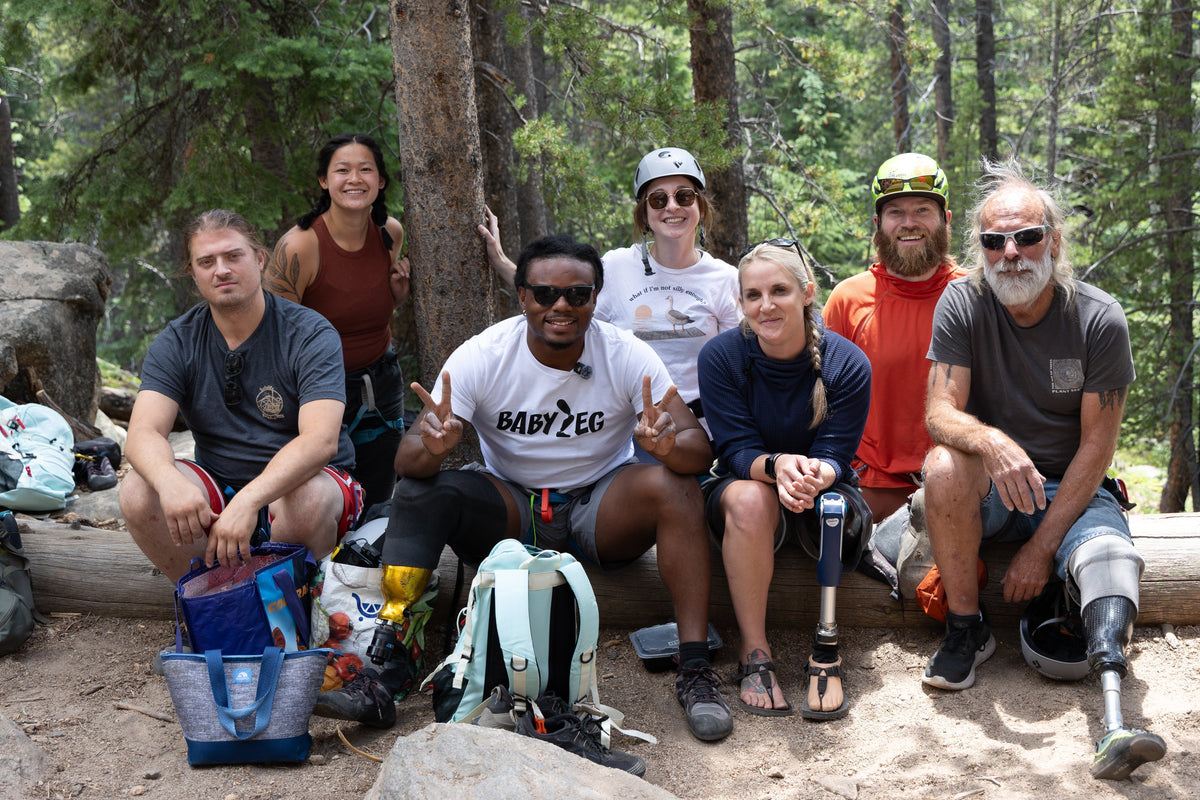
The Foundation became a public nonprofit in 2018 and has created outdoor recreation opportunities for veterans, amputees and others who might not otherwise have access to them. Snowboarding, rock climbing, mountain biking and expeditions have all been part of the work.
I've seen some of that firsthand through the Foundation's Women's Veteran Snowboarding Clinic at Sunlight Mountain Resort in Colorado. I taught during some of those clinics, where women veterans from across the country came together to learn to snowboard.
These were women who already knew how to do hard things. Snowboarding just gave them something new to figure out. I've watched women arrive not quite sure what they signed up for and spend the first day doing a lot more falling than snowboarding. Then something starts to click. A turn comes together. Someone who had been staring at her feet starts looking down the hill. A little speed stops being terrifying and starts being fun. By the end of the clinic, the same woman who was just trying to survive the run is getting to the bottom, grinning and asking when we're going back up.
When I asked Kirstie what she sees happening beyond simply learning a new sport, she described much of what I'd watched happen at Sunlight.
"There's a celebration," she said. "There's just so much that you grow through."
There's another side to it too. Other people can encourage you, teach you and help you back to your feet. But eventually you have to point the board downhill yourself.
"You do have to believe in yourself," Kirstie said. "You can pull that energy and that strength and that love from the people around you."
And when the clinic ends, the Foundation makes sure participants have a way to keep going. It helps cover travel, lodging, meals and instruction, and participants leave with the equipment they need to continue.
In fact, Kirstie hopes they eventually outgrow the Foundation.
Go home and ride with your family. Find a climbing partner. Join a mountain biking community. Take what you found there and build something of your own.
That idea fits with something else Kirstie told me. As she learned what worked for her, she began thinking about the person coming next. If she'd already spent years figuring some of this stuff out, why make somebody else start from scratch?
She doesn't want them to become the next Kirstie Ennis.
"Outdo me," she said.
Better. Faster. Stronger. Smarter. Take what she figured out, use whatever helps and then go farther.
Wanting people to outgrow the Foundation makes perfect sense. Success is someone leaving with more than they arrived with and seeing how far they can take it from there.
For all the enormous things Kirstie has done, I keep coming back to how practical that idea becomes through the Foundation. Pay for the plane ticket. Find the instructor. Get the gear. Bring people together. Give someone an opportunity they might not otherwise have, and make sure they have a way to keep going when it's over.
Writing it down makes it sound easy. Kirstie knows better.
Long before the Foundation, Kirstie's life was already moving in a lot of directions. In 2015, she walked roughly 1,000 miles across England, Scotland and Wales as part of Walking With The Wounded, honoring 25 fallen Marines along the way. She worked as a Hollywood stuntwoman, including on Patriots Day, became a firefighter and, in 2019, received the Pat Tillman Award for Service at the ESPYs.
It's an almost absurd amount of life to fit into a few paragraphs.
But when I asked Kirstie what "Find your line. Make it matter." meant to her, she didn't start with Everest. She didn't mention standing on top of six continents or snowboard racing.
She went back to being a Marine.
Kirstie had no intention of ending her active-duty career when she did. Being a Marine and being of service were deeply important to her. She talked about protecting people who couldn't protect themselves and wanting to be a source of hope or direction when someone needed it. When her injuries changed the future she expected, she had to figure out where that part of herself belonged next.
Some of the answer, it turned out, was outside.
Kirstie doesn't pretend she climbs mountains solely for anyone else's benefit. She climbs because she loves it. The mountains make her happy. Movement is good for her. Being outside gives her something she needs for herself.
I like that part of her answer.
There doesn't have to be a grand sacrifice where doing something meaningful requires giving up the thing that makes you happy. Kirstie found something that made her feel more like herself, followed it farther than most of us could imagine and found a way for something she loves to create opportunities for other people too.
"How special is it that I can use something that I'm so passionate about to change the lives of others?"
And Kirstie still gets to climb mountains.
That's Kirstie's answer to "Find your line. Make it matter."
Maybe that's also why Everest matters so much to this story even though she hasn't stood on top of it yet.
Kirstie's Wildline isn't about conquering every obstacle put in front of her. It isn't about doing everything alone, and it isn't about pretending limits don't exist. She has spent years figuring out which ones can be worked around, which require a different approach and which need to be respected.
Sometimes the answer has been to keep going. In 2023, standing roughly 650 feet below the top of the world, the answer was to turn around so she could come back.
She intends to.
Everest is still there. Kirstie still wants it. But there are already people riding, climbing and heading into the mountains because she helped give them a way in. Some of them may eventually go farther than she has.
Kirstie would consider that a success.
That's one hell of a Wildline.
If Kirstie's story inspired you, there's a very real way to support the work she's doing. The Kirstie Ennis Foundation says 93 cents of every dollar donated goes directly to programming, helping cover the experiences, instruction and equipment that give participants the opportunity to keep going long after a clinic ends.
Donate to the Kirstie Ennis Foundation.
Find your line. Make it matter.